Attention/
Brain Rot Is a Defense Mechanism
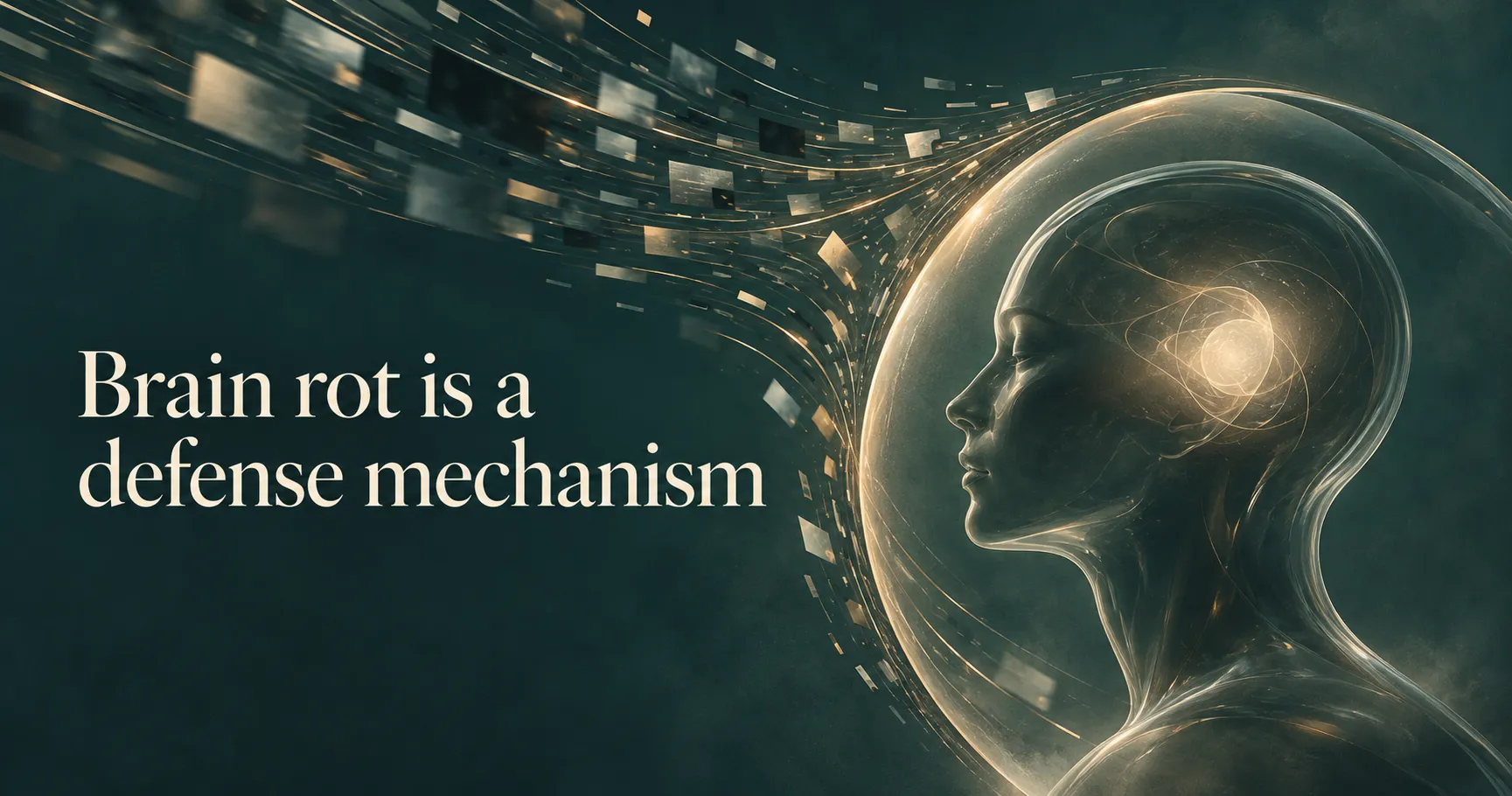
Too much information, too fast, and a brain that protects itself by paying less attention.
Introduction
We take in more information in a day than we can make sense of. News, messages, videos, and opinions arrive one after another, each asking to be taken seriously.
Taking all of it seriously would be too much. Picture a glass under a tap that never turns off. If the glass could protect itself, it would start letting less in. The brain seems to do something similar: it quietly turns down the attention it gives to everything.
Two things make this matter. It feeds itself: the less each thing gets, the easier it is to keep scrolling. And it doesn’t stay on the phone. It’s still there when we sit down to study, read, or work. Some of what we call brain rot may be exactly this: not the brain failing, but the brain defending itself.
1. Too Much, Too Fast
Feeling buried by information isn’t new. Long before phones, people had more books and papers than they could read, and they built summaries and indexes to cope. [1]
What’s new is the volume and the pace. A feed can jump from the news to a joke to a market update in a few seconds. Each jump asks us to start over before the last thing has sunk in.
That switching has a cost. In a small 2023 study, people who scrolled a fast-changing short-video feed were worse at remembering to do something they had planned. [2]
Too much, arriving too fast to sort.
2. How the Brain Protects Itself
Think of a crowded restaurant. At first you hear everything: voices, music, dishes. After a while, it fades into the background. You still hear it; you just stop listening.
Something similar may happen with information. Nobody decides to stop paying attention. The brain may simply begin spending less on each thing: a shorter look, less thought, less kept. It all keeps coming in, but less of it lands.
It may not simply be damage. It may be a way of coping with more than we can take in, one that protects us in the moment even if it costs us later. People already pull back from social media on purpose when it becomes too much. [3] This is the same pulling back, happening inside us before we notice.
When the stream won’t slow down, the brain gives less to each piece.
3. The Loop That Feeds Itself
Here is the trap. Paying less attention makes the flood easier to sit through. When nothing gets our full attention, nothing feels heavy, and one more video costs almost nothing.
So we keep going. More comes in, the brain turns down further, and the stream feels lighter still. Meanwhile, staying with one thing starts to feel tiring, so we move on sooner, which brings more of what started it all.
- OverloadToo much, too fast
- Less attentionLess given to each thing
- Easier to keep goingThe stream feels lighter
- More of the sameThe overload continues
Moving on becomes easier than staying with a thought.
4. It Follows Us Everywhere
The effects may reach much further than the time we spend on our phones. The brain can’t always tell in advance what will deserve attention.
Picture an evening of scrolling. Then you put the phone away and open a book. You read a paragraph, understand every word, and none of it stays. The videos have stopped, but your brain is still in that noisy restaurant.
It shows up in conversations, when we hear every word and lose the thread, and at work, when we miss a detail we’d usually catch. That’s the real cost: we understand less and remember less, even of the things that matter to us.
It’s hard to turn down only the noise, so a little of everything goes with it.
What This Means
Seen this way, brain rot isn’t the brain breaking. It’s the brain protecting itself from more than it can hold, and getting stuck in the loop.
A defense can ease when there’s less to defend against. Turn the tap down, and the glass has room to fill again.
What looks like losing attention may be the brain trying to save it.
PEACE . . .
Sources & further reading
- Bawden, D., & Robinson, L. (2020). Information Overload: An Overview.The history of overload and ways of managing it.Back to passage ↑
- Chiossi, F., et al. (2023). Short-Form Videos Degrade Our Capacity to Retain Intentions: Effect of Context Switching On Prospective Memory.Remembering plans across fast changes.Back to passage ↑
- Bright, L. F., Kleiser, S. B., & Grau, S. L. (2015). An exploratory examination of social media fatigue.Fatigue and pulling back from social media.Back to passage ↑