Efficiency/
The Efficiency Hand
The pressure behind better systems.
Introduction
An early curiosity about how things worked grew into an interest in why they kept changing. Something that seemed complete would later be revised or replaced. Those childhood observations left a question that became more practical with experience: what keeps pushing systems to improve?
Working with systems and products made the importance of efficiency more apparent. Small inconveniences gained weight through repetition. A process that worked at one scale could become difficult to sustain at another. New tools and approaches could make previously accepted effort avoidable, changing what counted as a reasonable way to work.
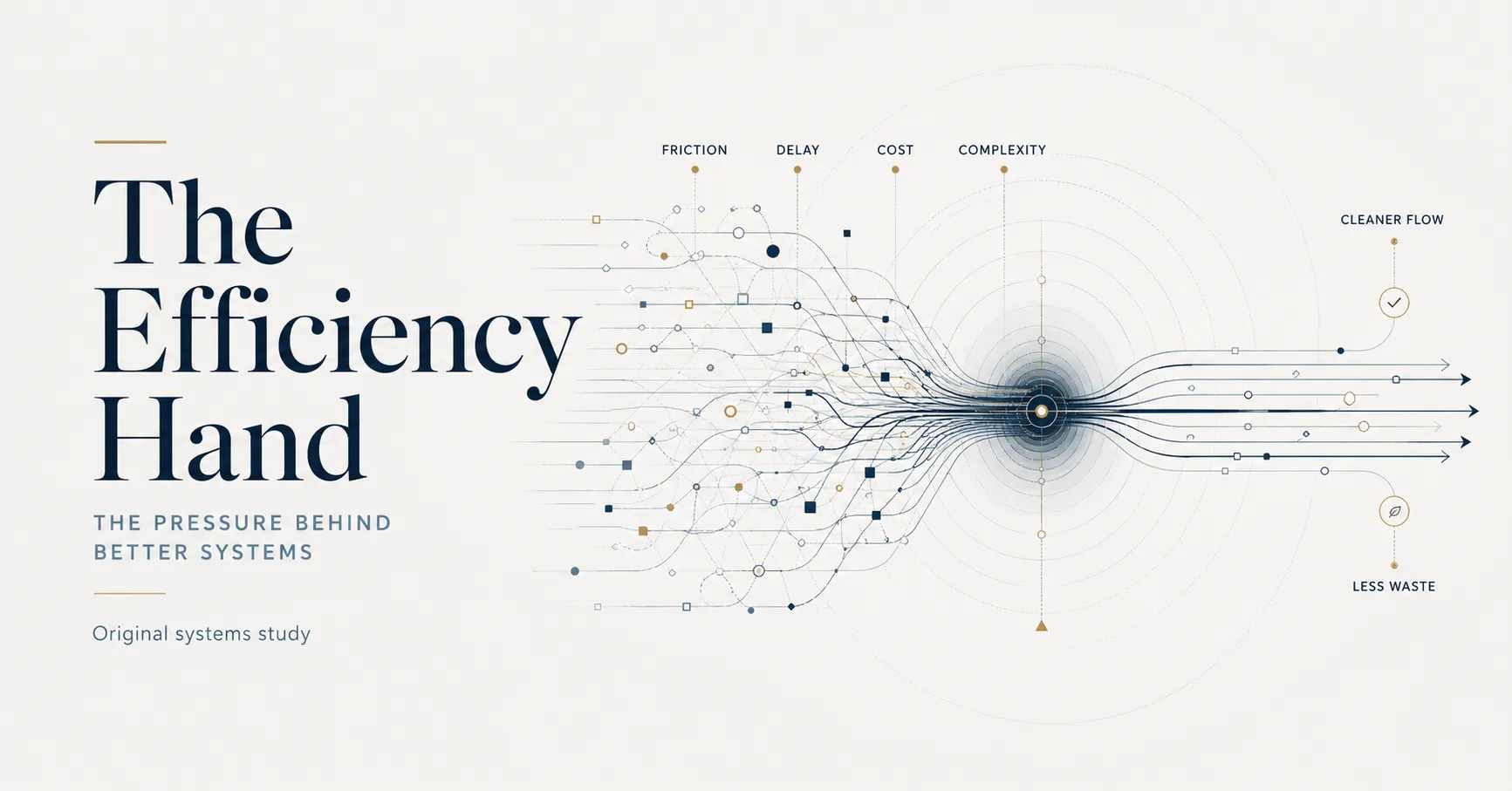
The Efficiency Hand brings these observations together: the pressure on systems to reduce avoidable waste and make better use of available resources. The discussion follows that pressure, considers what makes a change worthwhile, and examines the limits of what efficiency can achieve.
1. The Pressure Toward Improvement
Time, attention, energy, material, and money all carry costs. When a system uses more of them than its purpose requires, the recurring burden creates a reason to seek a better arrangement. The same question can be examined at any scale: how well do the available resources serve the intended result?
Waste is an avoidable use or loss of resources relative to a system’s purpose and practical alternatives. It includes unnecessary effort, preventable delay, rework, confusion, discarded material, and unused productive potential.
That pressure can grow as resources become scarce, demands increase, or a practical alternative appears. As alternatives become familiar, expectations change too: effort once taken for granted becomes harder to justify.
The “hand” gives a name to this combined pressure. Its effect depends on who experiences the cost, who receives the benefit, and who can act. Those carrying a burden may lack authority, while those with authority may benefit from the existing arrangement. Risk and switching costs can also outweigh a potential gain. Pressure can persist without producing change.
When change becomes worthwhile, improvement can take three forms:
- Remove what is unnecessary. Eliminate a repeated inspection that adds no useful information.
- Use existing resources better. Share underused equipment where coordination costs and availability allow it.
- Recover what would be lost. Put a discarded output to useful work, such as heat serving another process.
How a New Baseline Takes Hold
A method becomes established because it meets a need under particular conditions. When those conditions change, or a better alternative becomes practical, a new method can take its place. This suggests a recurring cycle:
Every new baseline carries the feeling of completion, as if the system has finally reached its most efficient form. Time reveals what remains unresolved. What felt like a ceiling becomes the floor of the next cycle.
2. What Counts as an Improvement
An update alone does not establish an improvement. A change needs to be judged by the work it removes, the work it introduces, and the outcome it preserves. This includes its effects on everyone involved and the effort of making it last.
Count the Whole Effort
A saving in one part of a system can create a burden in another. Asking customers to enter the same information twice may save the cost of connecting internal systems while adding work to every transaction. A confusing interface adds further effort in interpreting instructions or recovering from mistakes.
User effort belongs in the total cost even when it is absent from an internal measure. The same check applies to work moved to suppliers or costs deferred into the future. A burden moved out of view has not necessarily disappeared.
Include the Cost of Change
Investigation, implementation, training, and maintenance all consume resources. A small saving in an occasional task may never repay them. A method that changes frequently may be replaced before an improvement earns back its cost.
The same reasoning applies to recovering discarded resources: the useful output must justify the effort of collecting, converting, and using it. Preventing the loss may be the better option. In each case, the gain needs to justify the change while preserving quality, access, safety, and judgment.
Simplify Before Automating
The first step in evaluating automation is to ask whether the work still needs to exist. A redundant approval can move faster through software while remaining redundant. Automation applied too early can make waste faster, more consistent, and harder to see.
For recurring work, a useful default order is:
Remove unnecessary steps, standardize where consistency helps, then automate where reliable repetition repays implementation and maintenance. Preserve judgment where the work requires it.
Automated does not mean efficient. Sometimes it is only a faster way to repeat the same mistake. The question is not “Can this be automated?” It is “Is this clean enough to repeat?”
3. The Limits of Efficiency
Better use of resources still has to leave a system able to meet demand and respond to changing conditions. This places two limits on reducing resource use: some reserves serve a necessary purpose, and some workloads exceed the capacity available.
Spare Capacity Can Serve a Purpose
A buffer can look wasteful under stable conditions and become essential when conditions change. Time left between scheduled tasks, for example, can absorb an overrun without delaying every task that follows. Removing that room may improve utilization while increasing delay or recovery work.
Spare capacity earns its place when its protective value justifies its cost. Too little leaves the system unable to adapt or recover; more than a justified need adds cost without enough benefit. Inactivity alone does not make a resource wasteful.
When Capacity Is Still Insufficient
Efficiency can recover capacity lost to unnecessary work, sometimes enough to meet demand. A different response is needed when demand still exceeds what the system can reliably handle after that waste is removed:
Efficiency solutions don't solve capacity problems.
A workstation taking ten minutes per order can process six an hour. Removing two minutes of unnecessary handling raises that to seven and a half. If demand is nine an hour, the gain is real and the shortage remains.
The remaining shortage requires added capacity or an adjustment to demand. Waste and overload can coexist, so both need to be assessed. Identifying both prevents a real gain from being mistaken for a complete solution.
Avoidable work consumes resources without serving a necessary purpose.
- Rework or unnecessary steps may remain even at low demand
- Added capacity alone leaves the source of waste in place
- The response may be removal, simplification, or process redesign
Available capacity cannot reliably meet the required demand and service level.
- Queues and delays tend to worsen as load approaches capacity
- Variation can create queues even below full average utilization
- The response may be added capacity, scheduling, or demand smoothing
Where time is saved matters: relieving the bottleneck can raise overall output, while speeding a step with spare capacity may not. Variation in arrivals and processing times can also create queues before average capacity is fully used.
What These Observations Suggest
Systems continue to change as demands, alternatives, and constraints change. The Efficiency Hand gives a name to the pressure that makes a familiar arrangement worth reconsidering. Whether that pressure produces a useful improvement depends on the choices and conditions around it.
Examining a system begins with understanding what it needs to achieve, where effort is avoidable, and what limits the result. That provides a basis for deciding what to change, what to preserve, and how to judge the next baseline in use.
PEACE . . .